01
Human dignity
Secure the foundations of a healthy, safe and meaningful life for everyone.


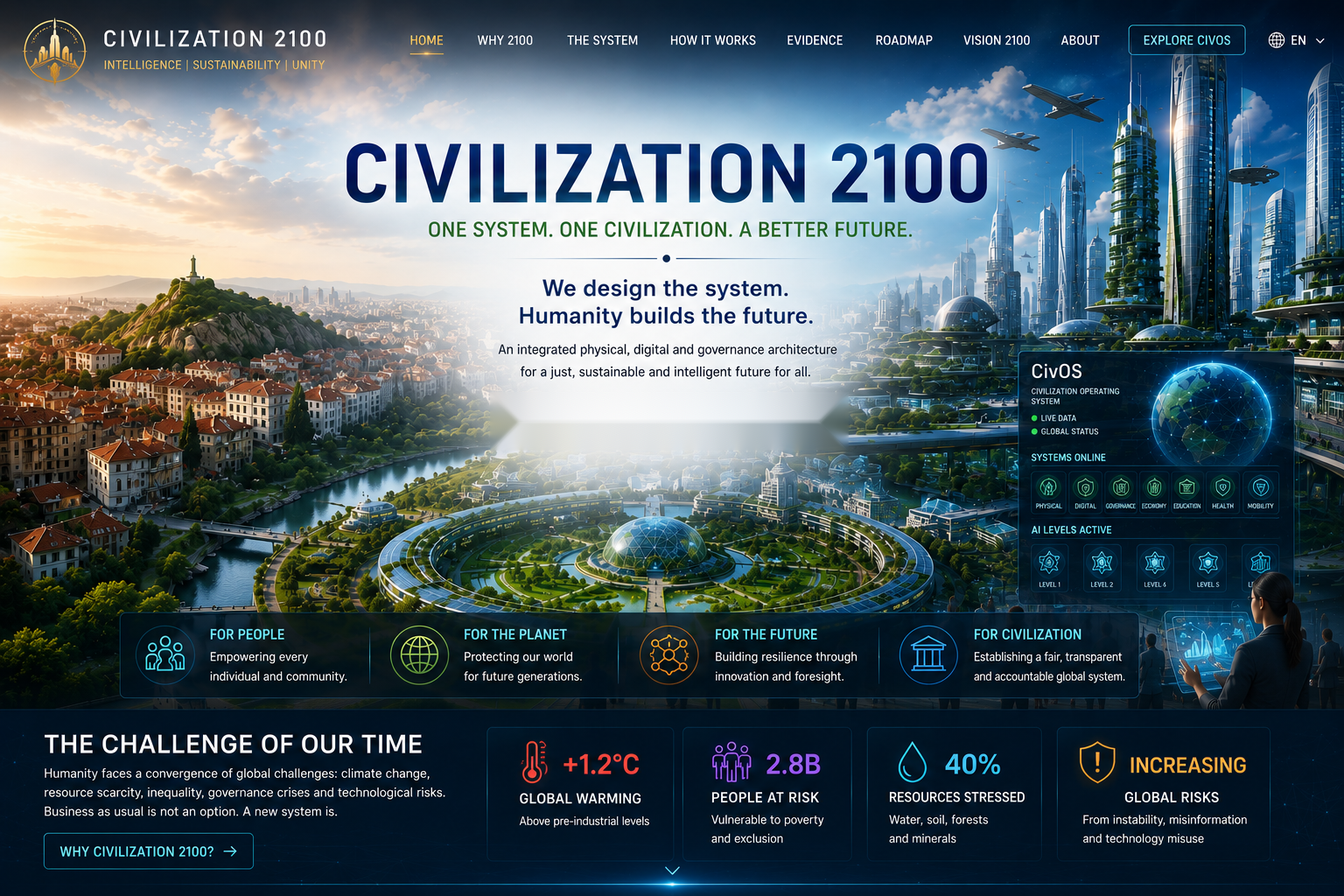
An integrated physical, digital and governance architecture for a just, sustainable and intelligent future for all.
Humanity is entering an era in which social, ecological and technological pressures can no longer be solved in isolation. Civilization 2100 begins with four foundations for designing a civilization that can remain fair, resilient and prosperous across generations.
Secure the foundations of a healthy, safe and meaningful life for everyone.
Measure prosperity against ecological reality, not consumption alone.
Design infrastructure and institutions to absorb shocks and keep learning.
Make long-term consequences visible in decisions made today.
The project connects physical infrastructure, digital intelligence, governance, economic coordination and human systems instead of optimizing each in isolation.
Short-term incentives obscure dependencies and move costs to other communities, ecosystems and future generations.
Resources, evidence, governance and technology work together around human well-being, resilience and planetary limits.
Civilization 2100 is not a single technology, institution or economic model. It is an integrated architecture in which physical infrastructure, digital intelligence, governance, economics and human systems continuously inform and strengthen one another.
Energy, water, food, materials, mobility, shelter and ecosystems.
CivOS, data, AI, digital twins, models and secure digital infrastructure.
Participation, transparency, accountability and evidence-based decisions.
UBS, resource-aware markets, incentives, value creation and planetary limits.
Health, education, culture, knowledge, communities and human potential.
Every layer shares data, constraints and outcomes.
Technology informs and coordinates; people retain legitimacy and agency.
Models, digital twins and validation support better decisions.
The system learns continuously from real-world outcomes.
Civilization 2100 does not ask one institution, one algorithm or one group to decide everything. It combines real-world data, transparent models, public participation, expert review and accountable human decision-making in a continuous feedback loop.
Citizens, communities, experts and institutions define priorities, deliberate trade-offs and retain authority over public decisions.
CivOS integrates data, simulations, digital twins and operational systems so decisions can be tested before they are implemented.
Independent review, auditability, constitutional limits and separation of powers constrain both institutions and AI systems.
Each step creates evidence for the next — and every outcome returns to the system as feedback.
Collect real-world conditions, needs, constraints and signals.
Build scenarios, forecasts and digital-twin representations.
Compare options against goals, risks and planetary limits.
People, institutions and experts examine evidence and trade-offs.
Authorized human institutions make the accountable decision.
Policies and operations are implemented through defined procedures.
Measure results, update models and improve the next decision cycle.
AI can recommend, simulate, detect anomalies and optimize within delegated boundaries. It does not become the sovereign decision-maker.
Every important recommendation is connected to assumptions, data sources, model outputs, uncertainty and an audit trail.
Decisions are made at the lowest level capable of handling the problem, while shared planetary issues use coordinated higher-level governance.
Sensors detect declining reserves. CivOS models demand, weather, infrastructure and ecosystem impacts. Citizens and specialists review options. The competent authority selects a response. Results are measured and fed back into the next model run.
Civilization 2100 treats every major assumption as something that should be measured, modeled, challenged and improved. The architecture is supported by quantitative models, digital twins, integrated feasibility analysis and continuous stress testing.
Defines what must be measured, how assumptions are tested and how evidence is connected across the architecture.
Population, materials, energy, water, environment and economics are modeled as connected systems rather than isolated forecasts.
Tests whether the combined system can actually satisfy human needs while remaining within physical and planetary constraints.
Digital twins allow proposed infrastructure, policies and operating models to be tested before they affect real communities.
A proposal is not accepted because it sounds plausible. It is progressively tested against data quality, model behavior, physical constraints, uncertainty and adversarial scenarios.
Performance is evaluated across human well-being, planetary health, resilience, equity, resource security and institutional effectiveness.
Website values are visual examples of the measurement framework, not claims of current global performance.
Civilization 2100 is tested against cyber attacks, resource shocks, governance failure, misinformation, migration, climate extremes and cascading system failures.
Every model should expose what it assumes and where uncertainty remains.
Important claims should survive review beyond the team that created them.
Results should be traceable to data, methods and documented procedures.
Evidence is not a one-time gate; models evolve as reality provides new information.
Civilization 2100 is designed as a phased transition, not a single global switch. The roadmap begins with measurable pilots, expands only when evidence supports it, and preserves local autonomy while building shared global capacity.
The first implementation horizon focuses on governance, CivOS, digital infrastructure, quantitative validation, site selection and a small number of real-world pilot programs.
Each phase expands the scope of coordination while retaining feedback, review and the ability to change course. The goal is not uniformity — it is interoperability, resilience and shared stewardship.
Build governance, CivOS foundations, pilots and institutional capacity.
Expand proven systems and connect regions, infrastructure and knowledge.
Increase deployment, regenerative capacity and cross-regional coordination.
Shift institutions and economies toward universal access and long-term resilience.
Align civilization with planetary limits and intergenerational stewardship.
A phase advances only when technical capability, public legitimacy, ecological performance and institutional readiness meet defined thresholds.
Models and pilots show measurable benefit.
Infrastructure and institutions can operate safely.
People and communities have meaningful participation.
Plans can change when evidence or conditions change.
These high-resolution architecture visuals provide the deeper implementation view behind the roadmap.
The full transition pathway from foundation to 2100.
The operational program for turning architecture into reality.
An illustrative first-year execution sequence and priorities.
How candidate locations can be compared through digital-twin evaluation.
Vision 2100 is not a prediction of one perfect city or one prescribed lifestyle. It is the destination implied by the architecture: secure foundations, regenerative systems, meaningful freedom, trustworthy institutions and technology that serves human potential.
A civilization can be technologically advanced and still remain humane, ecologically grounded and accountable. Civilization 2100 is designed around that possibility.
Universal Basic Services provide reliable access to health, education, housing foundations, food, water, energy, mobility and digital connectivity.
With essential needs secured, people have more room to choose work, learning, creativity, entrepreneurship, travel and the life they want to build.
Education, culture, science and meaningful contribution become central measures of success rather than secondary benefits.
Energy, food, materials and cities are designed to restore ecosystems, reduce waste and remain within planetary limits.
The goal is not to make everyday life feel like a control room. Good infrastructure becomes quiet: water is available, transport works, services are accessible, decisions are understandable and CivOS operates largely in the background.
Clean energy, water and local services are available without constant financial insecurity.
Education and meaningful work can adapt to skills, community needs and personal goals.
Mobility is accessible, and public issues can be understood through transparent evidence.
Time can shift toward family, culture, science, enterprise, community and creativity.
Civilization 2100 does not define success by growth alone. The intended direction is a society that is healthier, more capable, more resilient and less destructive to the systems that sustain it.
The first functional unit: a place to test whether the architecture can work at human scale.
The connective intelligence layer that coordinates data, systems, evidence and feedback.
The full architecture brought together as one operating model for civilization.
CivOS connects data, digital twins, autonomous AI systems, institutions and infrastructure so they can coordinate safely without collapsing into a single point of control. It is designed to connect, align, monitor and protect — while keeping authority distributed and accountable.
CivOS allows specialized AI systems to operate at the level appropriate to their role, while identity, permissions, policies and monitoring keep their authority bounded.
Local control loops, sensors, machines and devices.
Scope: localSpecialized systems for energy, water, mobility, health and other domains.
Scope: functionalCoordinates multiple domains across a settlement or region.
Scope: regionalBalances large systems such as energy, logistics, climate or economy.
Scope: multi-regionSupports global coordination, simulation and long-horizon planning.
Scope: advisoryCivOS separates capability from authority. An AI may be powerful in its domain, but it cannot simply take control of another system. Every interaction passes through explicit identity, permissions, policy boundaries and audit.
Every system is registered, authenticated and attributable.
Permissions are limited to defined functions and contexts.
Cross-system actions must satisfy governance and safety rules.
Competing objectives are escalated to coordination logic and accountable review.
Behavior, decisions and anomalies remain inspectable.
High-impact authority remains reversible and subject to human governance.
Explore the operating system, infrastructure, digital twin and distributed network architecture in full resolution.
The integrated operating model for people, data, systems and governance.
The resilient infrastructure foundation for CivOS and connected services.
How real-world systems are modeled, simulated and continuously updated.
How local autonomous cells connect regionally and synchronize globally.
How AI Levels 1–5 connect through CivOS, remain aligned and prevent cross-system domination or conflict.
Civilization 2100 is an open, systems-level project exploring how humanity could deliberately redesign the structures that shape everyday life — governance, economy, infrastructure, technology, resource use and long-term decision-making — so that human dignity and planetary stability reinforce one another rather than compete.
Humanity has extraordinary scientific knowledge, productive capacity and technological power. Yet many of our institutions still optimize for short political cycles, fragmented incentives, resource competition and problems treated in isolation. Climate pressure, inequality, misinformation, demographic change, automation, fragile supply chains and increasingly capable artificial intelligence make that mismatch harder to ignore.
Civilization 2100 begins with a simple question: if we know that the systems of this century will determine the conditions inherited by future generations, why should we leave their architecture to accident?
The project therefore treats civilization itself as a design problem — not in the sense that society can or should be centrally engineered, but in the sense that its shared infrastructure, protocols, institutions and safeguards can be made more coherent, measurable, transparent and capable of learning.
The objective is not to predict the future. It is to create a credible architecture for navigating toward better futures — one that can be tested, criticized, improved and adapted as knowledge and conditions change.
Every person should have a secure foundation from which meaningful freedom becomes possible.
Prosperity must operate inside the ecological systems that make civilization possible.
Claims, policies and designs should be measurable, testable and open to revision.
Greater capability — human, institutional or artificial — requires stronger oversight and responsibility.
Critical systems must survive shocks, failures and uncertainty without cascading collapse.
Decisions made today should account for people who cannot yet participate in them.
Civilization 2100 does not begin from the assumption that one historical economic or political model contains the complete answer. Capitalism, socialism, state-led development and resource-based thinking have each demonstrated useful mechanisms as well as serious failure modes. The project treats them as evidence: preserve mechanisms that improve human capability and resilience, redesign those that create structural harm, and reject the idea that a civilization must choose one inherited ideology as a complete package.
Entrepreneurship, decentralized experimentation, competition, price discovery and incentives can generate extraordinary innovation and adaptability.
C2100 retains these strengths where markets work well, while constraining monopoly, ecological externalities, extreme insecurity and incentives that reward short-term extraction.Universal access, public infrastructure, social protection and the principle that essential services should not depend entirely on purchasing power remain powerful civilizational tools.
C2100 incorporates universal foundations and shared infrastructure without requiring centralized ownership or planning of every part of economic and social life.Long-term infrastructure planning, industrial coordination, rapid execution and the ability to align large investments around strategic objectives demonstrate the value of institutional capacity.
C2100 separates those capabilities from authoritarian concentration of power: long-horizon coordination must coexist with rights, transparency, distributed authority and accountability.Jacque Fresco's Resource Based Economy and The Venus Project helped articulate a systems-level question central to C2100: what changes when civilization manages physical resources, technology and human needs directly rather than treating money as the primary representation of reality?
C2100 carries forward resource awareness, systems thinking, automation and human-centered design, while developing its own mixed-economy transition, governance safeguards, quantitative models, digital architecture and evidence-driven pilot strategy. EXPLORE THE VENUS PROJECT ↗Civilization 2100 is deliberately broader than a future-city concept. Its architecture connects the physical world with the digital systems that model it, the institutions that govern it, the economic mechanisms that allocate resources and the evidence frameworks that determine whether an intervention is actually working.
Civilization 2100 is based on the principle that core civilizational infrastructure — especially systems that influence access, public decisions or essential resources — must be understandable, inspectable and accountable. CivOS is therefore conceived as public-interest infrastructure rather than a private mechanism for invisible control.
Transparency does not mean exposing private data or weakening security. It means making objectives, authority, interfaces, decision rules, evidence and audit mechanisms visible enough for independent scrutiny. Privacy, cybersecurity and data sovereignty must be designed into the architecture from the beginning.
Civilization 2100 deliberately separates aspiration from validation. A compelling idea is not enough. The architecture must survive quantitative analysis, digital simulation, adversarial review and real-world testing.
Georgi Petrov is a long-time IT architect with nearly three decades of experience working with complex technology environments. His professional background is rooted in infrastructure and systems architecture — understanding how many independent components, dependencies, constraints and failure domains can be designed to operate as one resilient system.
That engineering perspective gradually expanded beyond information technology into a broader interest in sustainability, long-term resilience and the systems design of civilization itself. Civilization 2100 applies the same core discipline at a different scale: define the architecture, understand dependencies, remove dangerous single points of failure, model consequences, build safeguards, test assumptions and improve the system through evidence.
Civilization 2100 was initiated as an architecture project: an attempt to apply systems thinking, infrastructure design and long-horizon engineering discipline to questions normally discussed separately — how we govern, how we allocate resources, how we use AI, how cities function and what obligations the present has to the future.
The role of the founder is not to provide unquestionable answers. It is to establish a coherent architecture, expose its assumptions and create a framework in which specialists, communities and institutions can test whether better answers are possible.
No credible civilization architecture can be the work of one discipline or one person. Its development requires engineers, scientists, economists, urbanists, governance experts, educators, ethicists, security specialists, communities and many others.
“Civilization 2100 Team” represents that intended collaborative structure: a growing, multidisciplinary effort organized around shared architecture, transparent evidence and responsibility to the public interest.
The team's role is not simply to support a predetermined vision. It is to challenge it. Different disciplines must test the architecture from their own perspective, identify hidden assumptions and failure modes, compare proposed mechanisms with real-world evidence and help redesign components that do not survive scrutiny.
As the project develops, the team is intended to become the bridge between architecture and implementation: maintaining the common Civilization 2100 framework while coordinating research, quantitative models, CivOS and digital infrastructure, governance design, economic mechanisms, physical-system engineering, pilots, public communication and independent review.
The long-term objective is therefore not a closed design organization, but a distributed community of competence: people and institutions able to disagree constructively while working from shared evidence, explicit principles and a common responsibility to future generations.
It is whether humanity is willing to examine the systems it has inherited, decide what should be preserved, confront what is failing, and deliberately build institutions capable of carrying civilization through the rest of this century.
Civilization 2100 exists to make that conversation concrete.